Category Archives: Spoiler Alert!
Liz Tells Frank What Happened In “Arthur” (Not the Remake)
Dear Frank,
 So there’s often talk, when an older movie gets remade for modern audiences, if said remake is unnecessary or “too soon” — the answer usually being affirmative on both points. But what a remake does give its source material is some additional awareness– what I’m saying here is that I wouldn’t have watched the original 1981 Arthur this weekend if some Hollywood duder hadn’t said “Original scripts are lame! Let’s insert Russell Brand into some old movie! Are there any classic comedies where the protagonist has a substance abuse problem?”
For the moment, let’s leave the issue of the remake aside; the important thing is, I watched the original. And I enjoyed it! Arthur is, simply told, the story of a very rich guy who’s known nothing else — his name is Arthur, and his tale is told to the soothing beats of Mr. Christopher Cross’s classic tune “Best That You Can Do (Is Fall In Love).” Frank, let’s make this an audio-visual experience today, shall we? Play the below YouTube video so that you can listen to the theme from Arthur while we discuss it. Read the rest of this entry
Liz Tells Frank What Happened In Every John Grisham Novel Ever
Dear Frank,
 So sometimes, all it takes for an old passion to be renewed is something as simple as Netflix adding The Pelican Brief to its Watch Instantly service. The Pelican Brief AND The Client! What a glorious day that was.
You may not know this about me, Frank, but a large part of my early teens were spent obsessively reading John Grisham legal thrillers. They were my first independent taste of adult fiction — adult fiction that nonetheless can be read by a thirteen-year-old with a very bare-bones understanding of how sexytimes are supposed to work — and from them I gleaned my very shaky understanding of the court system and an odd fondness for jury duty.
But after watching all the Grisham Netflix had to offer and commencing a reread of The Runaway Jury (the only one of his novels I still own, mostly because it’s a weird “traveller’s edition” I bought during a trip to Europe in 1996) I’ve been reminded of why exactly I stopped reading Grisham novels after the age of fifteen — Grisham figured out one story he was good at writing, and while his early novels do enjoy some variation and creativity, he quickly fell into a pattern that has suffered from repetition.
In short, Frank, reading one Grisham novel means that you probably have a good grasp of every other novel, which is part of what made him such a popular author during the 90s. But really, it’s not so much that Grisham wrote the same book over and over again — it’s that many of his books, especially those written between A Time to Kill and The Brethern, take place in a very specific universe.
Here are just some of the Grishamverse’s qualities: Read the rest of this entry
Liz Tells Frank What Happened In “Sucker Punch”
Dear Frank,
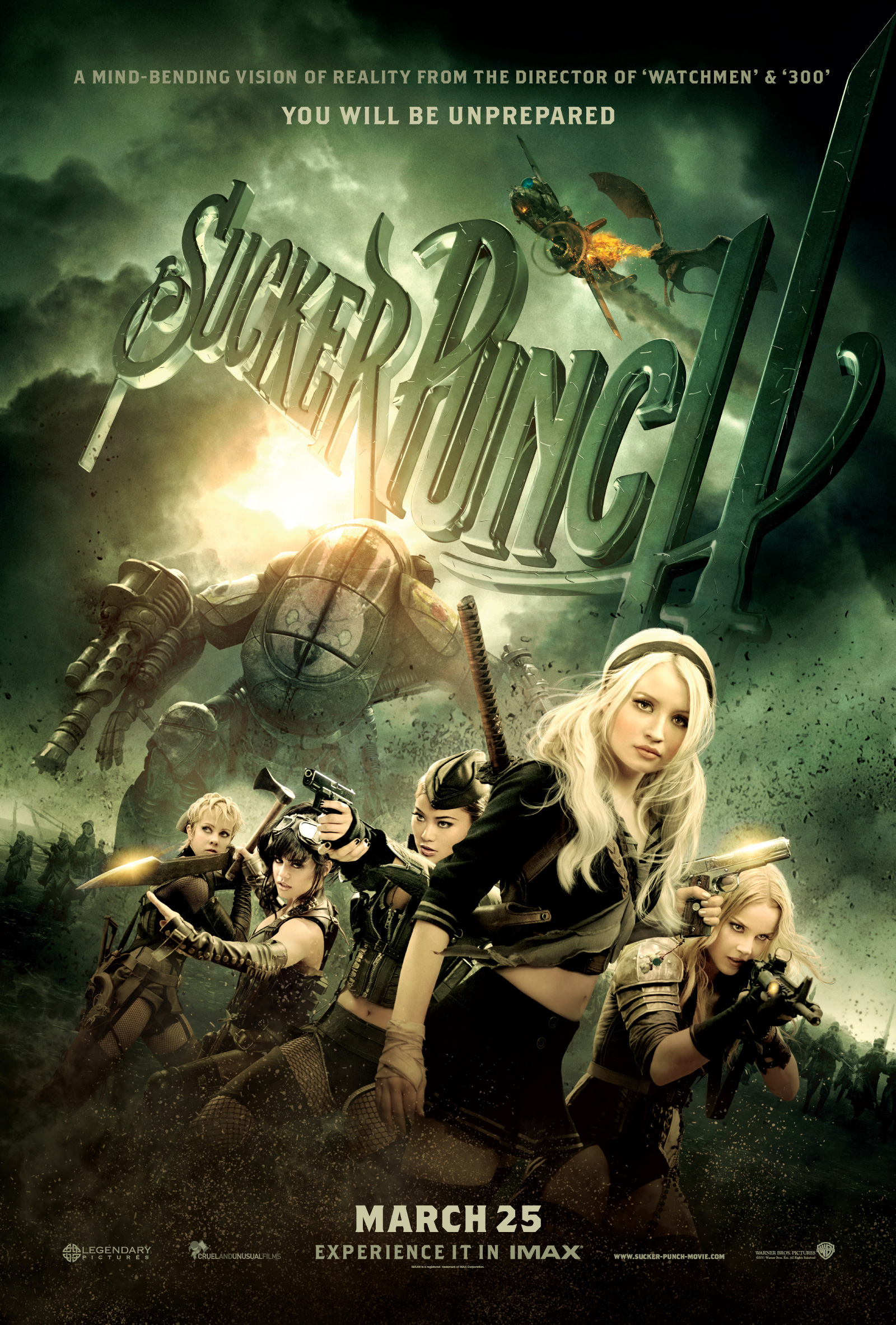 About two months ago, it got programmed into my brain that I wanted to see Sucker Punch, Zach Snyder’s “first original film” — in part because I’m a sucker for anything that might promise to be a girl power epic, and in part because I have a strange residual fondness for 300. (Not entirely because of this, but, yeah.) Combine that residual goodwill with the fact that American film is currently experiencing a drought of original premises and I like to support the ones that do make it into theaters, and you end up with me giving Zack Snyder my money on Sunday night.
Let’s end the mystery right here, Frank — if the movie had been great, I wouldn’t be writing this, and this installment wouldn’t be filled with SPOILERS. Read with caution.
Sucker Punch starts off by introducing a young girl only known as Baby Doll, who gets sent to a mental asylum by her evil stepfather after the death of her mother. (This movie does not deal in subtleties.) In the mental institution, she meets a pack of girls with whom she teams up for an escape attempt — because in five days, thanks to her stepfather bribing an orderly, she’s getting lobotomized.
What then happens? Read the rest of this entry
Liz Tells Frank What Happened In “Conan the Barbarian”
Dear Frank,
Thank you so much for telling me about My Neighbor Totoro last week! Miyazaki has always been a director I’ve struggled to appreciate, but there is the slightest chance that I now get what the big deal is.
 I can only hope I bring that same level of joy to today’s retelling of the 1982 classic Conan the Barbarian. Because let me be clear here, Frank — this movie is a delight. It’s a weird, slowly-paced flavor of delight, but its blunt, hypermasculine telling of a legend I have done absolutely no research into prior to writing this is downright arresting.
Lest you had doubts about this movie’s politics or message, Conan opens with a quote from Nietzsche about his beloved Ubermensch philosophy. When we meet the titular Ubermensch, though, he is but a little boy being raised by his father to believe in the god Krum, who lives in the ground and is responsible for all good things.
Life seems good for Li’l Conan, but then (because these are barbarian times) his home village is raided by an outside gang of troops, and they kill his parents and enlist him into slavery. Eh oh. Read the rest of this entry
Frank Tells Liz What Happened In “My Neighbor Totoro”
Dear Liz,
First of all, thanks so much for asking me to tell you about something this week. This blog has filled my life with so much warmth and information, and your efforts to shine an edifying light on the underdeveloped corners of my pop culture soul continue to make me a better human being. I know you’re having a busy week, so the least I can do is pick up the baton for once and tell you about a Miyazaki movie.

Liz, like many of us who spent our childhoods in the 1980s, I experienced a deep, early love of cartoons. It started with the animated shorts on Sesame Street and reached its zenith with the arrival of The Muppet Babies, whose imaginative flights of fancy and media mash-ups were the highlight of my Saturday mornings. But like many of us, I gradually realized that most of the other cartoons I was devouring were totally terrible: derivative, violent toy commercials of the crudest hand-drawn sort. (For me, the breaking point was probably the day I recognized the imperialist undertones of The InHumanoids.) In many ways, the 1980s were the nadir of American animation.
Meanwhile in Japan, the 1980s were an animation renaissance, spearheaded by the formation of Studio Ghibli, the company formed by animator-auteurs Hayao Miyazaki and Isao Takahata. I’ve seen a number of Miyazaki movies, but I’ve actually never seen My Neighbor Totoro, so I’m very pleased that we’re sharing it for the first time together. Read the rest of this entry
Liz Tells Frank What Happened In the “Sliders” Pilot
Dear Frank,
 Of all the terrible things about being a teenager, here is one that’s only really terrible in retrospect: There will be books and movies and TV shows you consume in your adolescence that, upon future reflection, might prove to be embarrassing, especially when you realize just how much they reveal about you. There’s an inevitability to this — the most you can hope for is that the media with that kind of power over your psyche won’t include a Vancouver-produced micro-budgeted Fox show about people who hop between alternate universes with the help of an oversized cell phone.
I am, alas, not so lucky.
The pilot episode of Sliders opens with Jerry O’Connell videotaping his experiments with wormhole technology in the basement of his mother’s house; blah blah blah science science science Jerry’s a genius, having successfully opened up a portal of some sort to a… I dunno. It’s a mystery! (The answer is parallel universes.) Read the rest of this entry
 Liz Tells Frank What Happened In...